Welcome to Beweisbar. This blog intends to address popular issues in science. To be completely honest, I write for selfish purposes.I take this blog as my motivation to learn because to be able to write something, I read articles, watch documentaries every week. I hope you enjoy reading the articles. For questions & comments, please reach me at mehmetkurtt@gmail.com.

Sunday, February 17, 2013

Conway's Game of Life


My favorite "Forrest Gump" moment is when Forrest quotes her mom and says : "Life is a box of chocolates, Forrest. You never know what you are going to get.". As simple as it seems, this amazing quote poses a fair question. Seriously, what is life?

We know that we are a kind of life form living in this planet since last 2 million years. We also know that what we have evolved from what might be called "very primitive cells", which probably did not appear until 4 billion years ago (Since the earliest known life form existed approximately 3.5 - 3.9 billion years ago).

How do you define a cat mathematically?
Due to our short life span, we are usually incapable of understanding very long time intervals. But I can assure you that a 4 billion years time span is a long journey! The incredible thing is that, the whole process happened within the laws of nature, so doesn't this make it possible to mathematically model the whole thing, at least in theory? 

John Conway is a prominent mathematician still actively working in the Department of Mathematics at Princeton University.  Fairly enough, Conway had the same questions in his mind. He says : "People think mathematics is complicated. Mathematics is the simple bit. It's the stuff we can understand." and continues, "It's cats, that are complicated. What is it in that small molecules that make one cat behave from one another? How do you define a cat? I have no idea!".


Yet in 1970, Conway showed that even though life could be baffling in its complexity, the complexity arises from simple rules. The evidence came from a game, whose results were so unpredictable and incredible, they called it: "Life".

The game had very simple ingredients. A board of grids, filled with contours, and the fate of each contour was determined by very simple rules; but unlike the natural laws we are exposed to in our universe, there were just 3 rules in this game.

The rules were the equivalence of birth, death and survival. What would happen to any particular square, depended on its neighbors.

1.An empty square with exactly 3 contours around it, gives birth, so a new contour is added to the board.
2. Any contour with too few neighbors dies by isolation, and is removed from the board.
3. Any contour with too many neigbors dies due to competition, and is again removed from the board. The only case for the contour to survive is when the contour has exactly 2 or 3 neighbors!

The strangest thing was, with only these basic rules, when they simulated this game on a board, creatures started to appear out of nowhere! Creatures that moved, creatures that fired out smaller creatures, pumps that looked like a primitive heart!


Try it out yourselves below and see the life with "no design"!                                                                                                  


3

Sunday, April 24, 2011

Parallel Universes

Hugh Everett was too wrapped up in his thoughts to be a parent
The Many Worlds of Everett
In April 1959, Hugh Everett III,along with his wife and baby daughter, went to Copenhagen, Denmark, to meet Niels Bohr and his colleagues. He was very excited. He had just completed his PhD thesis, called "Many Worlds Interpratation of Quantum Mechanics" and he was thinking that this was going to change the perspective of the whole quantum physicists. A bit eccentric and self-centered, he even thought he could be the Einstein of his era, to whom he was sending letters at the age of 12.
Niels Bohr talking to Hugh Everett ( 2nd one on the right),at the age 24
Contrary to his expectations, his trip to Copenhagen turned out to be a complete disaster. He was literally mocked by his fellow physicists, to the point that Léon Rosenfeld, one of Bohr's followers, described Everett as being "undescribably stupid and could not understand the simplest things in quantum mechanics". 

But what was Everett claiming that made Bohr and his colleagues so irritated? Let's give some insight first.In the quantum world, an elementary particle, or collection of those particles, can exist in a superposition of two or more possible states at the same time. For instance, an electron can be in a superposition of different locations, velocities and orientations of its spin. Yet anytime scientists try to measure one of these properties, they see a definite result. (just one of the elements of the superposition, not a combination of them).

Many of the founders of the quantum mechanics, namely Bohr, Heisenberg, von Neumann, had agreed on an interpratation of quantum mechanics - Copenhagen Interpratation , to deal with the "observer" problem. According to this view, at the moment of measurement, the wave function describing the superposition of alternatives appears to collapse into one member of the superposition, thereby interrupting the smooth evolution of the wave function and introducing discontinuity. However, there was one man who wasn't buying this: Hugh Everett.

Instead of Schrödinger's wave function, which can be thought of as a list of all the possible configurations of a superposed quantum system, he introduced  a universal wave function,that links observers and objects as parts of a single quantum system.Everett’s radical new idea was to ask, "What if the continuous evolution of a wave function is not interrupted by acts of measurement?". According to him, the universal wave function would contain every probability making up the object's superposition. He thought, all of these alternatives were part of the reality, which are branched and do not influence one another once formed. ( according to a fundamental property of Schrodinger's equation). For instance, during the measurement, although we are observing a definite result, in fact, all the possibilites that could happen, were happening in a different branch. He called these branches "many worlds".

Hugh Everett and his daughter Liz
Everett's family did not end up well. He left physics after completing his PhD, due to the lack of interest to his work and instead worked in defence industry. His daughter Lisa, who were having mental problems, commited suicide in 1996, leaving a note that "she was joining her father in a parallel universe." His wife died of cancer later, and the only surviving member of the Everett's family, Mark Oliver Everett turned out to be a rockstar, the lead singer of the alternative rock band Eels, who prepared a document describing his father and their relationship, called "Parallel Worlds, Parallel Lives".

Everett's great idea , although met scorn at his time, revealed that there are different universes where all of the physically possible events were actually happening. This was also a great cure for paradoxes related with the Double Slit Experiment and Schrödinger's Cat. "Many-Worlds" of Everett are later described by Max Tegmark, who is now a  top-physicist in MIT, as Level-III parallel universes. Apparently, he has 3 more.

The Universes of Tegmark

Max Tegmark is an iconoclast physicist in the Physics Department of MIT and he is the leading supporter of the "multiverse" idea in the physics world today. But why did this whole multiple universes idea suddenly start to sound reasonable to most of the physicists around the world? Well, because the M-theory suggested that our universe was made up of 11 dimensions, and the theory of inflation suggested that our universe was actually infinite.

So according to Tegmark, Level-I universes directly result from the fact that the universe is infinite. If space goes on forever, then there must be other regions like we live in—in fact, an infinite number of them. No matter how unlikely it is to have another planet just like Earth, we know that in an infinite universe it has to happen.

Level-II universes emerge if the fundamental equations of physics, the ones that govern the behavior of the universe after the Big Bang, have in fact more than one solution. So actually at the very moment of Big Bang, other universes with different kinds of physical laws, different solutions to those equations, might have emerged spontaneously . Universes with different realities that we cannot perceive!
Max Tegmark while explaining the birth of the universe
Level-IV universes is a phenomena invented by Max Tegmark himself. Max Tegmark has this crazy idea, called "Mathematical universe hypothesis", that the reality itself is not only described by math, but it is math! Therefore every statement in abstract mathematics in fact describes different realities and physical existences. So these other mathematical universes are made up of "external" realities, which are independent from our owns.

The moral implications of Parallel Universes

So, these all seem very abstract, but what are the implications of this idea? Well, the first implication, that is every physically possible event is actually happening elsewhere could be a comforting or dangerous idea at the same time. It may be comforting because you know that you are living an "ideal life"in another universe, in which you might be a rockstar, the top scorer in Premier League, the Nobel prize-winner, or in which you are never born.

Travis is rocking not only one, but multiple universes- You just can't see them.
It is also a dangerous idea because for instance if you commit armed robbery and shoot the cashier, why should it be a crime, while there are other universes in which it is actually not considered as a crime? Or as an alternative thought, after all, there are millions of parallel universes in which you didn't do it, or in which he shot you! That destroys the whole "universal" morality concept and leaves us with an infinite amount of choice for moral values and standards!

Now, you might think reading this article was totally a waste of time. But I assure you this will be a big hit in another universe.

If you are interested to read more about this subject, see:
"The Many Worlds Interpratation of Quantum Mechanics" Hugh Everett
"The Many Worlds of Hugh Everett", Scientific American
"Parallel Universes", Max Tegmark
"The Mathematical Universe", Max Tegmark
"Parallel Worlds, Parallel Lives", BBC Horizon Documentary
"Parallel Universes", History Channel


Thursday, April 14, 2011

Boltzmann & Evolution: An admirer of Darwin


On  May 29, 1886, Boltzmann gave what is now regarded as a very popular lecture at the ‘Festive Session’ of  the Imperial Academy of Sciences in Vienna. When he was asked about his opinions about the new century, he replied as follows:

". . . If you ask me about my innermost conviction whether our century will be called the century of iron or the century of steam or electricity, I answer without hesitation: It will be called the century of the mechanical view of nature, the century of Darwin. . . ."   

Boltzmann was right. Unarguably, Darwin has become one of the key scientists of the century, radically changing our views about the nature, and the meaning of existence and human life.

Boltzmann's views on evolution

Ludwig Boltzmann (1844–1906) was the first scientist who tried to reduce the biological theory of evolution to the thermodynamics and chemistry of the 19th century. For scientists at the end of the last century,  a great challange was that the  second law of thermodynamics seemed to forecast the final disorder, death, and decay of nature, while  on the other hand, Darwin's theory of evolution indicated developing living systems of order with increasing complexity. How was the increase of complexity among living things possible in a sea of disorder and thermal equilibrium?


To understand views of Boltzmann on biology and evolution better, let's go back to his lecture in Vienna and quote him again:

"… The struggle for existence of the living beings is not a fight for basic materials—these materials are available in air, water and soil in sufficient quantities for all organisms– nor for energy, which is plentiful in the form if heat, unfortunately untransformably, in every body. Rather it is a struggle for entropy that becomes available through the flow of energy from the hot Sun to the cold Earth. To make the fullest use of this energy, the plants spread out the immeasurable areas of their leaves and harness the Sun’s energy by a process that is still unexplored, before it sinks down to the temperature level of the Earth, to drive chemical syntheses of which one has no inkling as yet in our laboratories. The products of this chemical kitchen are the object of the struggle ion the animal world. . . ."


Going back to the question about the complexity of life, Boltzmann suggested some explanations which already remind us of modern biochemical concepts of molecular autocatalysis and metabolism. The origin of first primitive living beings like cells was reduced to a selection of molecular building blocks which Boltzmann imagined as a process like Brownian motion. Plants as cellular aggregates are complex systems of order. Thus, in the sense of the second law of thermodynamics, Boltzmann suggests, they are improbable structures which must fight against the spontaneous tendency of increasing entropy in their body with sunlight. According to him, photosynthesis, as he also implied above in his quote, is merely an attempt to compansate the spontaneous increase of entropy in the plants, which makes use of the Earth's energy with relatively low entropy coming directly from the Sun.

Boltzmann on the evolution of nervous systems and brain

 The next step for Boltzmann was extending his views to the evolution of the nervous system and the emergence of memory and consciousness. He claimed that the sensitivity of the earlier primitive organisms to outer impressions led to the development of special nerves and organs of seeing, hearing etc. He believed that  the human brain has been developed with the same perfection as the giraffe's neck or the stork's bill.

Boltzmann on socio-cultural developments

Evolution of morality? Boltzmann believed so.
It may seem quite exaggerated, but Boltzmann even did not hesitate to extend his views about evolution to sociology.  He tried to justify human categories of  space, time and casuality as tools developed by the brain for the survival of the race. He saw "morality" as a "constantly evolving"  weapon for the struggle of life. Later in his life, his "Darwinism" has reached to an incredible point that in 1905, he gave a lecture called  "Explanation of the entropy law and love by the principle of the probability calculus". Well, anyways...

Boltzmann: More Darwinist than anyone else in the history

If you are interested in finding out more about how Darwin effected Boltzmann's views and studies, you can also take a look at his other works, especially "Boltzmann Brain", with which he is trying to explain why the observed entropy is so low.

At the beginning of the 20th century, life still could not be explained by physical and chemical foundations. Earlier on, classical mechanics always considered deterministic and time-reversible patterns in the nature. (A frictionless ball, when you push it, would move forever). But life wasn't working that way. Humans are born, grow and die.-Why? Maybe Boltzmann's statistical interpratations about Darwinian evolution were not enough to explain the origin of life. However, he clearly made his point when he commited suicide in 1909 in Duino,Italy, a person who sees death as a senseless biological and cultural event.


If you are interested to read more about this subject, see:

"Thinking in Complexity", Klaus Mainzer.
"Boltzmann and evolution: Some basic questions of biology seen with atomic glasses",Peter Schuster
"Boltzmann,evolution,atomism,statistics",Peter Schuster
"Dangerous Knowledge", BBC Documentary

Next week: Parallel Universes

Monday, April 4, 2011

Infinitude of prime numbers: Euclid, Euler and the mathematical beauty


Euclid with his students
   
Euclid, as depicted above, used to love teaching and sharing his knowledge with others, and made this teaching process one of his daily routines. One day, a youth who had just begun to learn geometry with Euclid, when he had learnt the first proposition, inquired, "What do I get by learning these things?" So Euclid called a slave and said "Give him three pence, since he must make a gain out of what he learns." 

Euclid's answer probably summarizes why there are still people today, who are really not earning a lot , engaging in pure mathematics and spending their lifetime on a subject which will only be understood by a small portion of the human population on earth. Euclid, who is generally referred as the "Father of Geometry" was probably one of the scientists who enjoyed what he was doing the most. Therefore, it probably comes as no surprise that , he established one of the most elegant proofs in the math history- if not the most elegant one.

Euclid's proof

Are prime numbers infinite? Perhaps one of the most interesting things about the infinitude of prime numbers is that, nobody who is not interested in mathematics very much seemed to have a correct/reasonable answer about it. I usually get answers like "Hmmm,I don't know" from people when I asked about this. We can confidently say that the answer for this question is not intuitive, that is to say, it is not related with our everyday experiences nor observations.

When Euclid asked himself this question, and sought for an answer, he found out that the answer was very simple. A summary can be seen below.

Suppose that p1=2 < p2 = 3 < ... < pr are all of the primes. Let P = p1p2...pr+1 and let p be a prime dividing P; then p can not be any of p1, p2, ..., pr, otherwise p would divide the difference P-p1p2...pr=1, which is impossible. So this prime p is still another prime, and p1, p2, ..., pr would not be all of the primes.

Roughly speaking, as you might have already understood, suppose that the number of prime numbers are finite, and let the last prime number be pr   .So now if you multiplied all the prime numbers including pr  and just add 1 to it, you would get another prime number, which contradicts with the first assumption. Hence, prime numbers are infinite.

Not only me, but also lots of mathematicians agree that this is one of the most elegant and beautiful proofs in the math history. The fact that it is so simple and can even be understood by a primary school student makes you want to think : "That's it!".

Euler's proof

Leonhard Euler depicted on a 1983 stamp from the German Democratic Republic. The stamp also includes a diagram of an icosahedron and Euler's famous polyhedral formula 

The underlying idea of Euler's proof is very different than that of Euclid's. In fact,although more complicated,his proof is stronger and makes use of analytical methods. In essence, he proves that the sum of the reciprocals of the primes is infinite.  I can't say I am a big fan of Euler because of his intrigues against Daniel Bernoulli, which he conducted with Daniel's father. But anyways, you know what they say: “Render unto Caesar the things which are Caesar’s”.
 
He used the following equality between the regular harmonic series and the infinite products called "Euler products". In the right hand side, p refers to the prime numbers.Euler noted that if there were only a finite number of primes, then the product on the right would clearly converge, contradicting the divergence of the harmonic series. This is a direct result of the fundamental theorem of arithmetic. If you are not convinced, please see: "On the infinitude of prime numbers" by Shailesh A Shirali pg. 9-11.

                                    \sum_{n=1}^\infty \frac{1}{n} = \prod_{p} \frac{1}{1-p^{-1}}
=\prod_{p} \left( 1+\frac{1}{p}+\frac{1}{p^2}+\cdots \right).

Then, Euler took the natural logarithm of both sides and by using the properties of logarithm function he found:
                   
\begin{align}
& {} \quad \ln \left( \sum_{n=1}^\infty \frac{1}{n}\right) = \ln \left( \prod_p \frac{1}{1-p^{-1}}\right) = \sum_p \ln \left( \frac{p}{p-1}\right) = \sum_p \ln\left(1+\frac{1}{p-1}\right)
\end{align}
Since
 e^x = 1 + x + \frac{x^2}{2!} + \frac{x^3}{3!} + \cdots,
we get ex > 1 + x and x > ln(1 + x).

So;
 \sum_p \ln\left(1+\frac{1}{p-1}\right) < \sum_p \frac{1}{p - 1}
Hence \sum_p \frac{1}{p-1} diverges. (Because we know the left side diverges as it is equal to the natural logarithm of the sum of the  harmonic series.)But 1/(pi − 1) < 1/pi−1 where pi is the ith prime. Hence \sum_p \frac{1}{p} diverges.

This directly implies that , there are infinite number of prime numbers(otherwise the sum would converge).Perhaps none of you could guess a simple divergence test, which you probably learned in Calculus courses, would be the main element of such a beautiful proof.

Mathematical Beauty

Mathematicians usually describe a proof as elegant, when it is simple,unusually succinct, derives a result in a surprising way,is based on new and original insights and can be easily generalized to solve a family of similar problems. Probably one of the main requirements the mathematicians are defending to understand the mathematical beauty is that ,well, "you have to be a mathematician".
 
In his book, "Art of Mathematics", Jerry King draws a figure as depicted above to summarize the  aesthetic view of different people about mathematics.The people in the inner circle (like myself)are people very close to mathematics because they use it day by day, are the ES types (the engineers and scientists). Most engineers and scientists appreciate mathematics solely and only because of its utility. 

The point outside the two concentric circles, point P, represents people who don't care about mathematics. (including most non-science and non-math teachers) These “P people” are unfortunately in the majority.

And according to King, you could only see the beauty of mathematics if you are in the gray zone. That is, if you are a mathematician :) Well a bit arrogant, but who can oppose it ?

Sunday, March 27, 2011

How Gödel broke the taboo of time travel

When you are talking about Kurt Gödel with me, you'd better be careful as you are probably speaking with the one of the biggest admirers of him in the universe. It's unarguable that he is one of the greatest minds in the science history however for me he is rather an inspiration to follow an academic career. Once the famous mathematician Fermat wrote for his mysterious claim, later known as "Fermat's Last Theorem" in Arithmetica as follows : "I have discovered a truly marvelous proof of this, which this margin is too narrow to contain". I can confıdently repeat this statement for Gödel. This margin is too narrow to contain him.

Until several decades, time travel has only been a topic of sci-fi movies, books and articles and merely an imagination of human mind, along with other supposed superstitions. Probably , people were having a "thoughtless" fun while reading Memoirs of the Twentieth Century, in 1733, in which a guardian angel was traveling to 1997-98 from the present. But I do not think people were just "enjoying" themselves on the discussions about the TV series Lost, while brainstorming on conspiracy theories based on time travel and Einstein's relativity theory. (Get over it, the series did not have a scientific point at all :) )

But , if time travel suddenly started being taken seriously by physicists and scientists in general, who broke this long-lasting taboo?


Gödel's Universe

In 1949, Gödel published a paper called "An example of a new type of cosmological solutions of Einstein's field equations of gravitation" to honor his best friend and Princeton neighbor Einstein. In his paper, he constructed a hypothetical universe, derived from the equations of the general theory of relativity, that admits time travel into the past; it is infinite, static (not expanding), rotating, with non-zero cosmological constant. It was an exact solution to Einstein's field equations and it had many, literally many strange properties.

I am not sure if Einstein felt quite honored though. Gödel must have been quite an annoying person for the scientists of his time.First, with his "Incompleteness theorem", he probably ruined everyone’s day in math, which basically pointed out that every system of math capable of computing addition and multiplication produces some true conclusions that the system itself can’t even prove it is true.

His new universe was also annoying for physicists, especially for Einstein. He tried without success to find an error in Gödel's physics or a missing element in relativity itself that would rule out the applicability of Gödel's results-but he failed.

The results were shocking. In Gödel's hypothetical universe, you could not only travel "anywhere" but "anywhen" also.


How is time travel possible in Gödel's universe?

Schematic view of Gödel's universe

 Above, the two vertical lines are a world line of a matter particle (which may be regarded as a galaxy). These particles are always at the same distant. However, the center vertical line is a center of rotational symmetry.  The rotation of the universe  (which Gödel introduced into his model) produces a peculiar effect on the light-cones, as is shown in the figure above. The center light-cone is up-right, but as we go farther from the center, the light-cone tilts and widens. For the universe is rotating around this center , according to special relativity, the velocity of a particle changes the hypersurface of simultaneity and also the direction of the time axis. 


In the Gödel's universe, there is a critical distance from the center; at which the light-cone becomes tangent to the plane (hypersurface) of simultaneity of the central light-cone. And beyond this critical circle,( see the circles in the first figure of this topic) the light-cone straddle the plane. This means that a light ray can go below the plane , as shown above.

The shocking implication of the mentioned phenomena is that, this makes time travel possible! Imagine that , in the above figure, your galaxy was once at point p. But now you are at q. In order to visit p again in the timeline , you first accelerate and aim at the outside of the critical circle for the light rays to be able to go below the plane. Then when you passed the critical circle, you go downward for a while, enough below the original hypersurface at p. Next, you aim at the critical circle (below p, of course), and if you passed it, you aim at p, from the past region of p. Thus you came back to your past by also travelling through your future! This makes defining the cosmological time  impossible! (This section is a summary of Hawking and Ellis,1973) 


 Time travel is possible.....theoretically

This seems all fine, but if this is a hypothetical universe, how did that help breaking the taboo of time travel in science communities? Well, because Gödel showed that you can "theoretically" make time travel possible, without having to deal with practical issues. Since then there have been lots of hypesthesia for time travel, which requires another article to explain.(along with the paradoxes they brought. See: Grandfather paradox)

Who knows? Maybe one day the humanity will be able to travel through the time. One thing that is certain to me is that, we will need more geniuses to chit chat with each other as below.

Gödel and Einstein


Monday, March 14, 2011

Graham's Number and Infinity

Ronald Graham and his wife Fan Chung
What is the biggest number that you know of? Centillion, googol,googolplex? A googol is 10100  and  a googolplex is  10Googol  , which is already an unbelievably large number. Of course you can go on forever, by taking the powers of these numbers until you reach the infinity. But what is the largest number that is "useful" for mathematics? The answer is the mysterious Graham's number. Graham's number is so ridiculously huge that  it trumps googolplex by a long shot.

"The Mathemagician"

Ronald Graham is not one of those "high IQ, low EQ" mathematicians that you are familiar with. He is the only one of its kind, and the people tend to call him " The Mathemagician". Literally... Believe it or not, he is "a highly skilled trampolinist and juggler", and the past president of the International Jugglers' Association. In fact, he was even on stage with Cirque du Soleil (recently visited Istanbul for a set of shows) and in an issue of Discover magazine about the Science of the Circus.


Ronald Graham while juggling

Recently a professor in  the Computer Science Department of UCSD(University of California at San Diego), Prof. Graham considered a problem in Ramsey theory, and gave a "large number " as an upperbound for its solution. Since then, this number, known as Graham's number, became well known as the largest number ever used in a mathematical proof. It was so large when compared with the largest numbers previously used in mathematics that, people had tough times in perceiving it.Well actually, they still do.Perhaps the most ironic thing about this number was, it was an upper bound solution to a problem to which most of people would give the trivial answer: 6. Isn't it quite hilarious that we cannot even calculate how many times Graham's number is bigger than 6 today?


Graham's Number

Graham's number is connected to the following problem in the branch of mathematics known as Ramsey Theory:
Consider an n-dimensional hypercube, and connect each pair of vertices to obtain a complete graph on 2n vertices. Then colour each of the edges of this graph either red or blue.
What is the smallest value of n for which every such colouring contains at least one single-coloured 4-vertex planar complete subgraph?
Well , this may sound quite complicated and I do not want to bore you with details, so let's proceed with what Graham's number really is.

 
\left. 
 \begin{matrix} 
  G &=&3\underbrace{\uparrow \uparrow \cdots\cdots\cdots\cdots\cdots \uparrow}3 \\
    & &3\underbrace{\uparrow \uparrow \cdots\cdots\cdots\cdots \uparrow}3 \\ 
    & &\underbrace{\qquad\;\; \vdots \qquad\;\;} \\ 
    & &3\underbrace{\uparrow \uparrow \cdots\cdot\cdot \uparrow}3 \\
    & &3\uparrow \uparrow \uparrow \uparrow3
 \end{matrix} 
\right \} \text{64 layers}
where the number of arrows in each layer, starting at the top layer, is specified by the value of the next layer below it; that is,
G = g_{64},\text{ where }g_1=3\uparrow\uparrow\uparrow\uparrow 3,\  g_n = 3\uparrow^{g_{n-1}}3,
So to explain better we can say that g(1)= 3^^^^3 meaning basically 3^27. For g(2), there will be g(1) number of arrors between 3s, that is to say g(2)= 3^^^^.....^^^3, where the number of ^'s is g(1) and so on until g(64) , which is the Graham's number itself.

It comes as a no surprise to say that this is an unbelievably huge number, so huge that if we could write each number of the Graham's number on every atom in the observable universe, it would not be enough.  As a result:
1.We will never learn how many digits it has.
2. We will never learn the first digit of the Graham's number
3.We will never learn if there are more 1s than 0s in Graham's number

Well, we will pretty much never learn anything.  Why am I so confident? Can't a modern computer in the future store the Graham's number? The entire number is far too big to be stored in perfect precision by any computer that has ever existed or ever will exist. How can I say "ever will exist"? Because, even written in scientific notation, i.e. with only one digit of precision, the number of digits in the exponent would exceed the number of atoms in the observable universe. The total number is easily larger than the number of Planck volumes into which the observable universe can be divided. If the whole observable universe were a computer, and every tiny quark and neutrino represented a bit of data, it could not store the entire number in absolute precision.

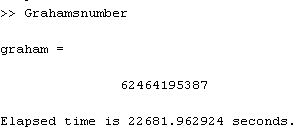
The only thing we can do about the Graham's number is that we are able to calculate the last digits of it by using the "modular exponentiation" technique. In fact, I implemented this technique in a Matlab code ( you can download it HERE), and I was able to calculate the last 11 digits of the Graham's number in , well, 6 hours. Either I need a better computer or I should quit writing programs so inefficient :)

It is obvious that the size of Graham's number is beyond our perception. But the ironic thing is, you, me and Ronald Graham is  exactly at the same distance with infinity: Infinity

Monday, March 7, 2011

Multiverse: The place where everything started off?

Science has come to a point in which one started questioning things more than ever. I do not know of any time in history where science had caused so many philosophical questions arise. "How did I get here?" , "Why am I here","What will happen after I die". Well , science has always been pretty good at answering "How" and "What" questions and it certainly has never liked "Why" questions and always seemed to dismiss them. Because scientifical theories are constructed to "explain" the way things happen in the best and most accurate way possible. For example, Newton's theory of gravity is good enough to explain the "macroscopic" events around us , however , it fails at the "quantum" level where "general relativity" lends a helping hand.

Big Bang is probably where science fails at a lot of questions. Frankly, "Big Bang Theory" tells  almost nothing about the "Big Bang" itself. For a start, it doesn't say "what" banged, "how" it banged and "why" it banged. It is only concerned with how the universe came to being "after" 10^-37 seconds from the  very moment Big Bang happens. From this point backwards, science & physics fail. What I mean by "failling" doesn't mean that they need improvements, they "utterly" fail. Because for years scientists accepted that time started at the very moment of Big Bang, and there was an "absolute nothing" before that. That is why all the equations etc go to infinity and blow up at the moment of Big Bang.


With the discoveries of spring theory, 11th dimension and finally M-theory, scientists now strongly believe that Big Bang is not a beginning. Actually, with the new way of thinking, it is absolutely nothing. They claim that our universe is actually not alone and is floating in the "multiverse" in the 11th dimension along with the other "infinite number" of universes. A big bang is nothing more than a collision of two universes, which, they believe ,happens very frequently. That way, they are able to explain the moment Big Bang happens, because it is not a "singularity" any more but rather it is one of the infinitesimal "instants" in the multiverse history.


This may seem like sci-fi , but as long as it is not "falsified" and it is enough to explain the history of the universe, it will definitely keep on being taken seriously. Actually there are extensive research projects now to find out any proof in our universe about the collisons with other universes . From a sci-fi point of view, it raises a lot of questions:

1. Is it possible to travel between different universes? 

2.If there are infinite number of universes in the multiverse, are there infinite number of civilizations since the beginning of the multiverse( if that makes any sense)?
3.How advanced are they(other civilizations) in technology? Why could they not find the way to travel between universes? Is it impossible?
4. Can our universe collapse in a matter of seconds due to a  severe collision with another universe? (As some scientists argue that our universe is actually colliding with others even now)
5.What caused the multiverse to emerge? How did the first universe came to being?


It might quite be true that we are only some "things" with  some complex electrical signals going through our nervous systems and being interpret by our brains, living in a "planet" located in a universe,which is merely one of the infinite number of universes floating in the multiverse, whose size our brains cannot perceive. Humiliating for the human beings? I think so. Crazy? Well, like Bohr said, is it crazy enough to be true?

Mehmet Kurt